Two of the moments that decide a missing person locator happen at the surface, minutes apart: the count before a blast, and the check before a miner goes down.
Most conversations about mine personnel tracking are about what happens deep underground. That matters, but it is not where a system is most likely to be judged, and it is not where the consequences are sharpest. A missing person locator that cannot be trusted at those two surface moments has not earned its place, however good its underground map looks.
Both moments, as it happens, play out in or around the single hardest radio environment on the mine. That is not a coincidence worth ignoring.
The moment before a blast: shaft clearance
Before a mine blasts, it has to be certain that nobody is left underground. This is shaft clearance, and it is as close to an absolute as safety gets: the answer the mine needs is that the number of people below is zero. Not "about zero", not "the map looks empty", but a count it can stand behind before it initiates a blast.
That reframes what the tracking system is being asked to do. Underground, a slightly stale or slightly coarse location is often good enough to guide a search. At shaft clearance it is not, because the failure mode is not inconvenience, it is a person still underground when the blast goes off. A single tag that is missed, or a read that does not register at the shaft, is the difference that matters. So the property being tested here is not accuracy, it is dependable detection at the points people leave through, and a headcount trustworthy enough to bet a life on.
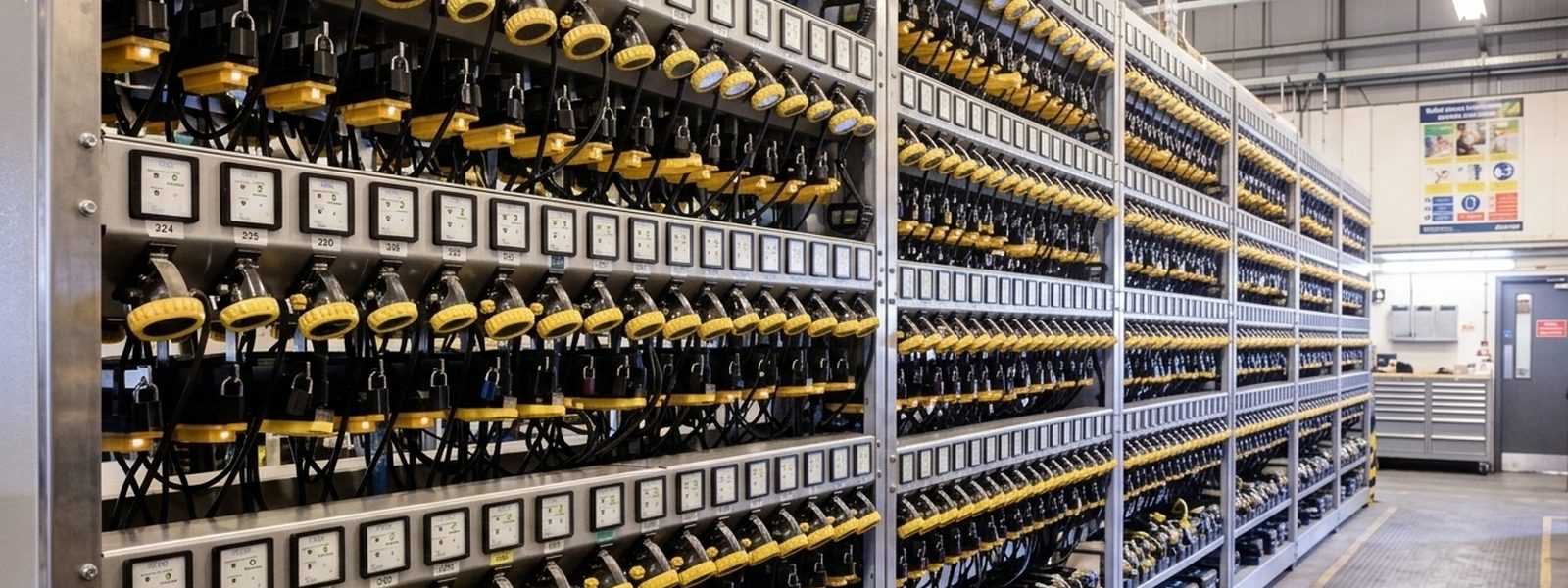
Because the stakes are that high, good practice never rests shaft clearance on a single system. It is built from independent, overlapping checks. The most basic is physical: the lampsman inspects the charging pockets and confirms that every lamp has been returned to its charging pocket after the shift, because a lamp not on charge points to a person not accounted for. The Time and Attendance system gives a second, independent account of who went in and who came out. A real time location system adds a third layer, and this is where it earns its place: not as the sole authority on clearance, but as a live, continuously logged check that augments the manual and Time and Attendance methods and can surface a discrepancy between them.
That framing sets the bar an RTLS has to clear. To be worth adding, it must detect every person reliably as they exit and produce a count trustworthy enough to sit alongside a physical lamp check, not one that quietly disagrees with the rack and the register for reasons nobody can explain.
A live picture that looks convincing but cannot be reconciled with the other two systems does not strengthen clearance, it weakens confidence in it.
The moment before descent: is the tag even working?
The second moment is quieter but just as revealing. Mines increasingly want to confirm that a miner's tag is actually working before they are allowed underground, rather than discovering a dead or faulty tag only when they go looking for its wearer. A tag that has not charged, has drifted, or has quietly failed is worse than no tag, because it creates false confidence in the very system meant to protect the wearer.
This is a functional check at the point of issue or at the shaft: the tag is present, alive, correctly associated with the right person, and being seen by the system. Regulation 16.7's requirement for functionality testing points squarely at this. The check is only useful if it happens before descent, every shift, and if the result is recorded rather than assumed.
Why these two moments are hard: the lamproom
Here is the catch. Both moments happen in and around the lamproom, and the lamproom is the most hostile place on the mine for radio.
Underground mines charge their cap lamps, and increasingly their tags, on steel charge racks. A single lamproom can hold thousands of them, commonly one to five thousand, and at large operations closer to ten thousand, all in one room. So at exactly the times the system is being asked its most important questions, it is facing two compounding problems at once. There is extreme density: thousands of tags packed into a small space, all potentially trying to be seen at the same time. And there is metal everywhere: racks of steel from the floor to head height, which reflect and absorb radio, create dead spots, and detune antennas.
Density and metal each defeat systems on their own. Together, in the one room where clearance and the descent check take place, they are a genuine stress test. A technology that reads a few dozen tags flawlessly on a demonstration bench can behave very differently when several thousand tags and a wall of steel are added. The reads slow, collide, or drop, and the very count the mine is relying on becomes the least reliable it will be anywhere on site.
What this means for choosing a technology
The place to start is to test a proposed technology against the right scenario, not the easy one. A missing person locator is often specified on underground accuracy and battery life, and then deployed into a lamproom that was never part of the conversation. The questions that actually decide whether it works are different:
- How does it behave when several thousand tags are present in one localised area at once? Does the read rate hold, or does it degrade as the population climbs?
- How does it cope with dense metal: reflection, dead spots and interference around steel charge racks?
- Can it detect every person reliably as they exit, so a shaft clearance count can be trusted absolutely?
- Can it confirm, before descent, that an individual tag is alive, correctly assigned and being seen?
Notice that accuracy to the meter barely features in that list. What matters at these moments is reliability under density and interference, and dependable presence detection, not pinpoint position. A technology chosen only for its precision underground can still be the wrong choice if it cannot survive the lamproom.
How the main positioning technologies hold up
Density is, in the end, a radio problem, and radios are limited by how many conversations can happen at once without talking over each other. That is where the technologies diverge sharply.
Wi-Fi and plain Bluetooth Low Energy share the same weakness: very few channels. Bluetooth Low Energy does its discovery on just three advertising channels, and Wi-Fi in the 2.4 GHz band has only three non-overlapping channels. Put thousands of tags in one room and they are all competing for the same sliver of spectrum, so transmissions collide and reads are missed, which is precisely what you cannot afford at shaft clearance. There is a second limit on top of the spectrum one: the reader hardware itself. A Wi-Fi access point degrades well before its theoretical client ceiling, and a Bluetooth gateway that holds connections can carry only so many at once, so the infrastructure becomes its own bottleneck long before the room is full. Neither was designed for several thousand devices packed into a lamproom.
Ultra-wideband is prized for pinpoint accuracy, but its usual ranging method has each tag hold a back and forth exchange with each anchor, which does not scale well when the tag count is very high. It can be pushed to high densities, but only with a one-way, tightly scheduled architecture that is complex and infrastructure heavy, and accuracy to the centimeter is not what the lamproom or shaft clearance actually needs.
Quuppa sits in an interesting middle. Its tags are transmit-only, broadcasting Bluetooth direction-finding packets that fixed locators listen to and turn into an angle, so it avoids the back and forth that limits ultra-wideband and is used at real scale, in warehouses and stadiums with tens of thousands of tags. It manages the resulting airtime pressure in the tags themselves, quietening stationary ones, and can even use a channel outside the crowded standard bands. The trade-off is that its accuracy wants a dense grid of cabled locators, which is costly to install and awkward to keep working in a wall of steel, and at very high densities the shared airtime still forces a lower update rate per tag. It is capable under density, but it buys that with infrastructure.
Mesh technologies such as Wirepas are built for exactly this problem. Because devices coordinate locally and schedule their own transmissions across multiple channels, a mesh can pack an extraordinary density of radios into a small volume without collisions, and it extends naturally as the workings advance. Chirp spread spectrum earns its place for a different reason: its signal is inherently robust in multipath, the reflected and scattered radio you get around walls of steel, so it holds up where signal-strength methods get confused.
None of this crowns a single winner for a whole mine, and the honest answer still depends on the site. But for the specific combination the lamproom imposes, thousands of tags in a confined, metal-dense space that has to yield a trustworthy count, an extensible mesh and a multipath-robust technology are the natural candidates, and channel-scarce or exchange-heavy approaches are the ones to scrutinise hardest.
The record is part of the requirement, not paperwork
Both moments produce something the mine has to keep: the clearance that authorised a blast, and the check before descent that authorised a descent. These are not administrative afterthoughts. They are the evidence that the safety process was followed, and Regulation 16.7's data logging requirement expects them to exist. A tracking system that shows the right thing in the moment but stores little of it leaves the mine unable to demonstrate, later, that it did what it was supposed to. The system of record behind the tags is doing as much of the compliance work here as the tags themselves.
What good looks like
A short way to pressure test a missing person locator against these two moments:
- Shaft clearance rests on independent, overlapping checks: a physical lamp and pocket inspection, Time and Attendance, and RTLS. The RTLS layer detects every person reliably at exit and reconciles with the others rather than contradicting them.
- A miner's tag can be confirmed alive, correctly assigned and visible to the system before that miner is allowed underground.
- The chosen technology has been shown to hold up under lamproom conditions: thousands of tags in one area, surrounded by metal.
- Both the clearance and the check before descent are logged and can be reproduced afterwards.
If a proposal cannot speak to all four, it has been designed for the easy part of the problem.
How Ideas2Impact helps
We start from the moments that carry consequences rather than from a datasheet. That means designing a missing person locator that can be trusted at shaft clearance and before descent, testing the technology against the density and interference of a real lamproom rather than a demonstration, and making sure the records those moments require are actually kept. The right technology is the one that survives the mine's hardest environment on its most important day, and that is the standard we design to.
Would your tracking system survive the lamproom?
We will give you a straight view on how your current or proposed system would hold up at shaft clearance, before descent, and in the density and metal of a real lamproom.
Start a conversationThis article is general information, not legal or compliance advice. Confirm your specific obligations, and the behaviour of any technology under your own conditions, with your appointed advisors and through testing on site.